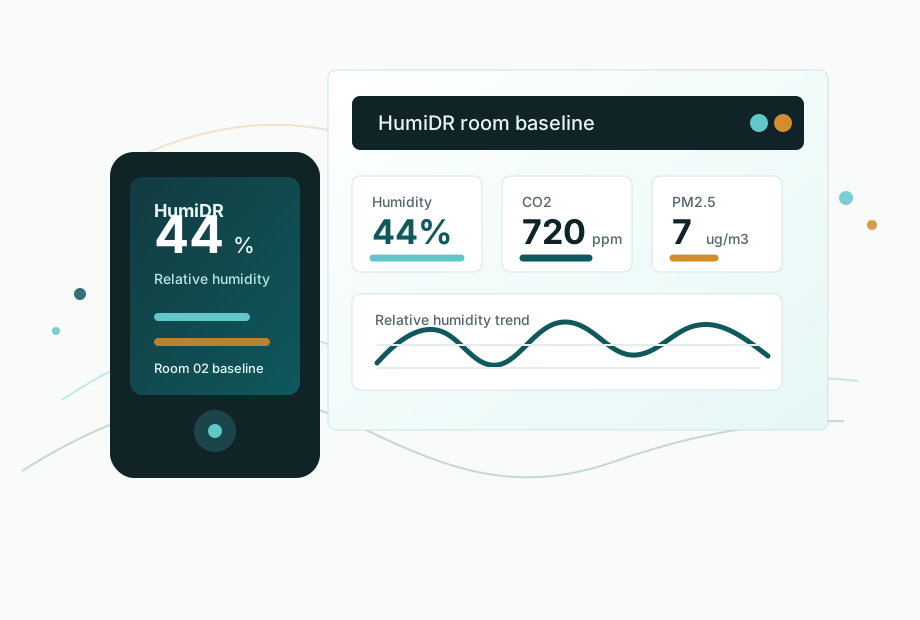
Monthly room summary
Room 02 baseline
Waiting room | May 2026 | 30-day monitoring pilot
Humidity stayed inside the target review band most days. CO2 rose during afternoon occupancy, which may be worth reviewing with the ventilation schedule.
HumiDR Monitoring
HumiDR places compact sensors in representative rooms and turns humidity, temperature, CO2, particle, and VOC indicator readings into simple reports.
Built for small commercial buildings that need practical visibility, not a lab report.
What it is
HumiDR is designed for spaces where comfort complaints repeat and operators need a clearer record of what the room is doing over time. It helps you move from one-off observations to trend-aware maintenance decisions.
Monthly room summary
Waiting room | May 2026 | 30-day monitoring pilot
Humidity stayed inside the target review band most days. CO2 rose during afternoon occupancy, which may be worth reviewing with the ventilation schedule.
Signals tracked
What is included
HumiDR is built to support maintenance decisions. Reports avoid medical claims and focus on patterns that can be acted on by the building team, BHEIR AirCare, HVAC partners, or other qualified professionals.
Monitors are placed in representative rooms and labeled so reports connect readings to real spaces.
Reports show humidity range, trend notes, CO2 and PM patterns, and practical observations.
Email alerts can flag conditions that stay outside a configured review band.
Each room can include context such as occupancy, HVAC schedule, comfort complaints, or cleaning patterns.
HumiDR trends can support BHEIR filter service, service logs, and quarterly recommendations.
When a mechanical, environmental, or specialist issue is suspected, reports can recommend the right next professional.
Deployment process
We choose the rooms that best represent recurring complaints, occupancy, moisture risk, or public use.
Monitors are placed where readings are useful and less likely to be blocked, bumped, or misread.
A pilot period shows how each room behaves during normal use, cleaning, weather changes, and occupancy cycles.
We look for persistent high humidity, dry periods, CO2 peaks, particle events, and VOC indicator changes.
Reports point to practical next steps such as filter service, ventilation review, dehumidification, HVAC referral, or portable filtration.
Claim-safe monitoring
Indoor-air conditions are affected by filtration, ventilation, humidity, source control, occupancy, weather, and building conditions. HumiDR helps make routine signals visible so the right maintenance or professional review can happen.
HumiDR does not diagnose health risk, prevent disease, or make medical-grade claims.
Humidity trends can be useful context, but mold testing requires qualified environmental assessment.
HumiDR is not intended for life-safety, regulatory compliance, or emergency response use.
FAQ
A HumiDR monitoring setup includes one or more compact room monitors, baseline collection, trend review, persistent humidity alerts where configured, and simple reports with practical next steps.
No. HumiDR is a trend-monitoring and maintenance-awareness service. It is not a laboratory test, certified IAQ inspection, medical diagnostic device, or mold test.
CO2 trends can show when occupied rooms may deserve ventilation review. They do not diagnose a mechanical problem by themselves, but they can help identify patterns worth discussing with an HVAC professional.
No monitoring service can guarantee mold prevention. HumiDR can help reveal persistent humidity patterns that may deserve maintenance, dehumidification, HVAC, or environmental review.
Yes. HumiDR is the monitoring layer behind BHEIR AirCare. BHEIR can use HumiDR trends to support routine filter replacement, service logs, humidity checks, and recommendations.